
REVIEW · BAVARIA · HOLLYWOOD AND CELEBRITY HOME TOURS
Bamberg: Where Hollywood dreams and movies are born
Bamberg has played more film roles than you might expect. This two-hour walk links the old town’s handsome lanes with locations from The Flying Classroom, The Sams, The Three Musketeers, and The Empress. I like the old film photos shown at the exact filming spots, and I like how the route gives you a quick introduction to Bamberg’s major sights at the same time. The main drawback is practical: a large group can make the guide hard to hear.
I also like the friendly, family-ready style reported from guides such as Emma and Brid. Children can ask questions, and the film angle gives familiar buildings a fresh purpose. The tour costs $15 per person, which is good value if you enjoy movies or want a lively introduction to central Bamberg, but it is conducted in German only.
Key points at a glance
- Film locations come first: See places used in The Flying Classroom, The Sams, The Three Musketeers, and The Empress.
- The Three Musketeers made Bamberg look like Paris: The production brought as many as 400 filmmakers to the city.
- Old-town sights fill out the route: The walk includes the Obere Brücke, Schlenkerla, Domplatz, the Old Court, and Bamberg Cathedral.
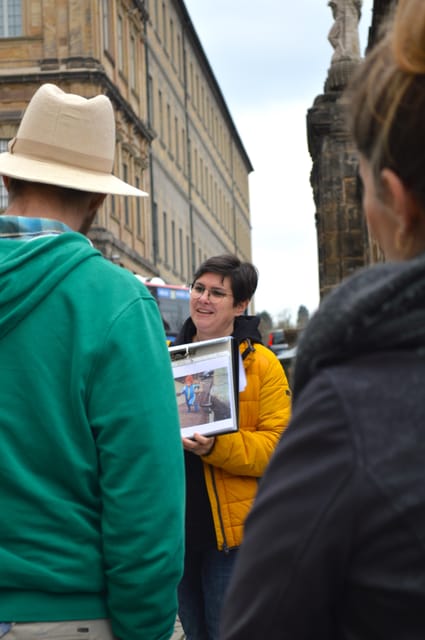
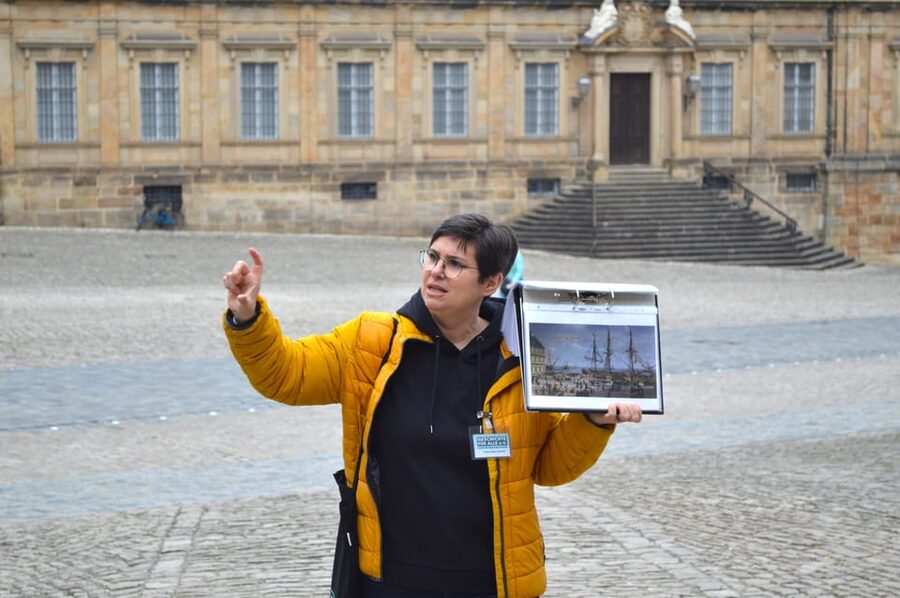
- Visual proof makes the stories click: The guide uses photographs of film scenes at the places where they were shot.
- A short, easy-to-plan walk: The tour lasts two hours, remains on foot, and finishes at Domplatz.
- Best for German speakers and families: The guides have been praised for answering children’s questions and keeping the walk relaxed.
Starting beneath Bamberg’s Old Town Hall
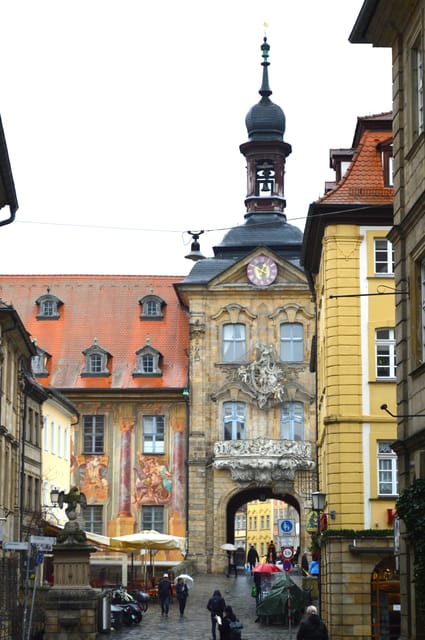
The tour begins at Obere Brücke 2, at the entrance to the Altes Rathaus. Look for a guide holding a picture folder and wearing a name tag from Geschichte Für Alle e.V. This is a useful meeting point because the Old Town Hall sits directly in the middle of Bamberg’s scenic historic core.
The starting location also sets the mood. Bamberg’s Old Town Hall appears to float between the banks of the Regnitz, with the bridge leading you straight into one of the city’s most photogenic corners. Here, the film theme becomes more than a list of movie titles. You begin to see why directors choose Bamberg: old facades, narrow lanes, grand civic buildings, and streets that can suggest another century with very little dressing.
Your guide introduces Bamberg as a city that has repeatedly been altered for the camera. A building may appear as a school, a Parisian street, an imperial setting, or a family film location, depending on the production. That behind-the-scenes angle adds a useful question to ordinary sightseeing: what am I really looking at, and what has been changed for the scene?
More Hollywood and celebrity home tours around the world:
- Los Angeles: Warner Bros. Studio Tour Hollywood
★ 4.6 · 7,191 reviews - Full-Day Iconic Sights of LA, Hollywood, Beverly Hills, Beaches and More
★ 5.0 · 6,147 reviews - Warner Bros. Studio Tour Hollywood
★ 4.5 · 5,246 reviews
Following The Flying Classroom to the Aufseesianum
One of the early film stories concerns The Flying Classroom, the 1973 movie starring Joachim Fuchsberger. The route visits the Aufseesianum, which appeared in front of the camera in that production.
For film fans, this is one of the strongest parts of the walk because you are not simply hearing that Bamberg was used as a set. You are connected with a specific building and a specific movie. A picture folder helps the guide show what the location looked like on screen, so you can compare the real building with its filmed version.
The appeal works even if you have never seen the movie. The guide uses the location to explain how Bamberg can be presented as something different while remaining recognizably itself. You see the building as part of the city, then as part of a story created for the screen.
The tour does not turn into a technical film-school lecture. Instead, you get practical insight into the basic craft of location shooting: choosing a building, framing an alley, dressing a street, and making a familiar place fit a period or fictional setting. That keeps the information useful for a general audience.
Through the alleys with The Sams
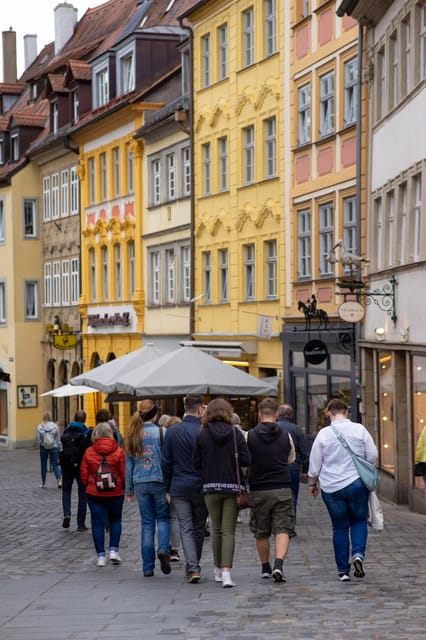
The walk then follows Bamberg’s winding medieval streets toward the Samshaus, a location linked with The Sams, the 2001 family film. The movie’s playful character and family appeal make this section especially suitable for parents and children.
This is where the tour can feel more animated than a standard architectural walk. The old town is no longer only a group of historic facades. Its lanes become part of the route followed by Ottfried Fischer, Günter Strack, and the cheeky Sams. The guide points out how the film used these streets and shows related images at the actual locations.
A German-speaking family may get the most from this section, especially if children know the film. Still, the visual comparison gives the stop value even if your film knowledge is limited. You can see how directors use the bends, doorways, and changing views of an old town to create movement and character.
One guide, Veronika, was praised for answering children’s questions well and keeping the experience satisfying for the whole group. That is worth noting if you are choosing between a formal history walk and something with a lighter tone. This tour still introduces real places, but it gives younger participants a reason to pay attention.
Pfahlplätzchen and the art of dressing Bamberg
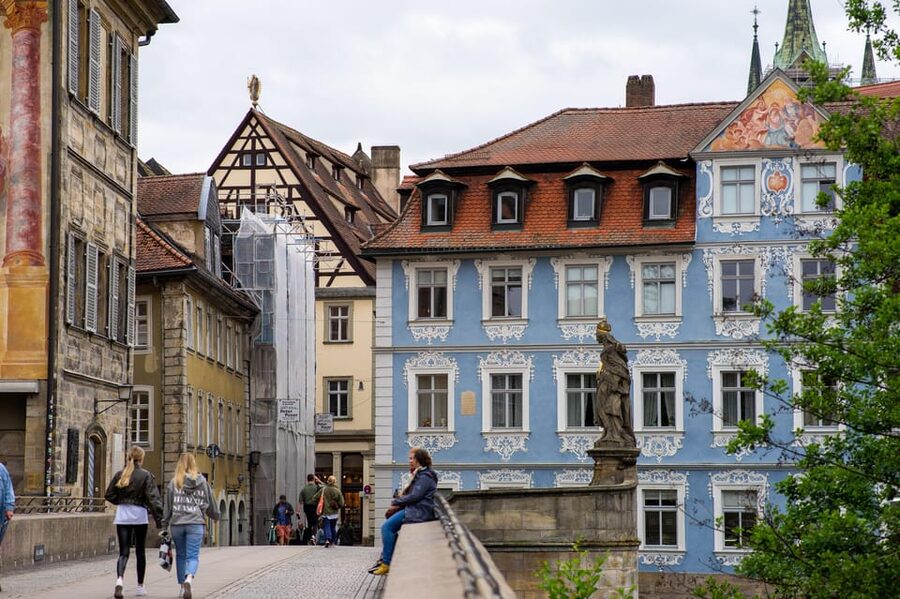
From the film locations connected with The Sams, the route continues to Pfahlplätzchen. This picturesque spot offers another chance to understand how Bamberg can be dressed up for a production.
The phrase dressed up matters here. Filmmakers do not always need to build a complete set. Sometimes they adjust signs, vehicles, clothing, street furniture, or storefront details. At other times, they choose a location because it already looks close to the period they need. Bamberg’s old center gives productions a strong starting point.
The guide’s photographs make this easier to grasp. A verbal explanation can leave you thinking only about the movie title. A scene image held beside the real location shows exactly what changed and what remained. One of the strongest comments about the tour praised this direct method, with film scenes explained at the places where they were made.
This is also a useful point to enjoy the city on its own terms. You are not being asked to ignore Bamberg’s architecture in favor of movie trivia. The film stories give you another way to look at the same streets, and that second layer is the real value of the experience.
A few more filming locations around the world worth a look
- From London: Harry Potter Warner Bros Studio Tour
★ 4.7 · 26,588 reviews - Magical London: Harry Potter Guided Walking Tour
★ 4.7 · 22,044 reviews - London: Warner Bros. Studio Harry Potter Tour & Branded Bus
★ 4.7 · 19,194 reviews - Edinburgh: Harry Potter Magical Guided Walking Tour
★ 4.8 · 11,944 reviews
The Three Musketeers turns Bamberg into Paris
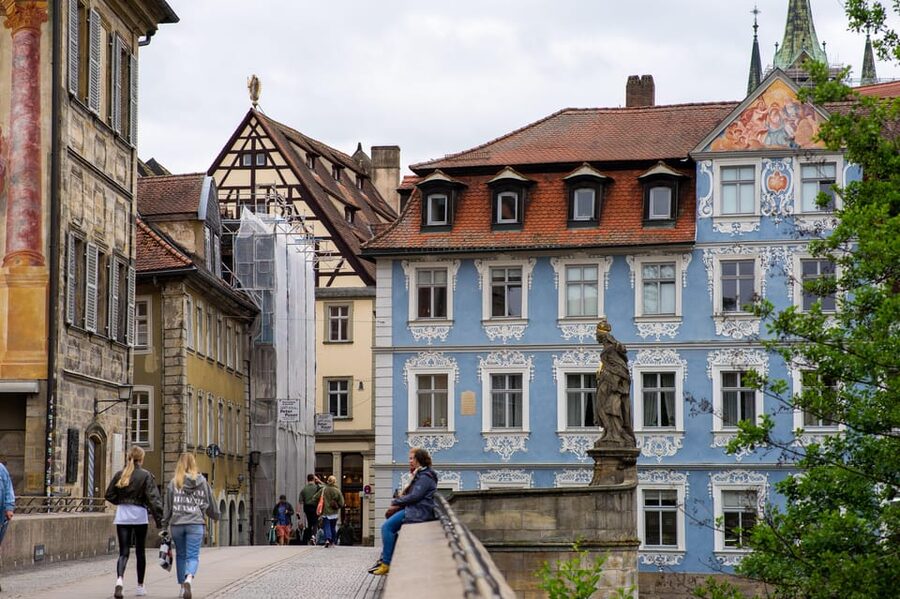
The biggest production story on the route involves The Three Musketeers, released in 2011. Bamberg was transformed into 17th-century Paris for the film, and the production brought as many as 400 filmmakers to the city.
That figure helps explain the scale of the work. A large period production needs more than actors and cameras. It may involve costume teams, set dressers, lighting crews, assistants, and many other workers. A quiet German old town can become a temporary international workplace when a major movie arrives.
The tour pays particular attention to this transformation. You learn how the city’s existing streets and buildings were adapted to suggest Paris in another period. The point is not simply that Bamberg appeared in the movie. It is that the city’s identity was temporarily redirected through costume, props, framing, and production design.
For you, this section offers the clearest look at filmmaking as a group effort. It also gives Bamberg a broader cultural connection. The city was not merely a convenient backdrop. Its historic center had the shape and texture needed to support a much larger story.
If you are visiting with someone who does not care much about film, this is still likely to be one of the more interesting sections. The scale of the production creates a clear sense of how movies reshape public spaces. It also helps you notice details that ordinary sightseeing can pass over.
Schlenkerla and the route toward Domplatz
The walk includes Schlenkerla, Bamberg’s well-known historic brewery and restaurant, before continuing toward Domplatz. The stop is part of the guided route rather than a separate tasting or meal, so you should not expect food or drink to be included.
Schlenkerla fits the tour’s central idea because it contributes to the look and feel of Bamberg’s old town. Its presence helps connect film locations with everyday city life. You see a working historic place, not only a building selected for a camera.
From here, the route heads to Domplatz. The walking stretches between stops are short, listed at roughly two to five minutes. That makes the tour manageable for most people who are comfortable walking through historic streets. You will spend much of the two hours standing while listening, looking at locations, and moving between them.
The route does not involve transport between sights. That is a plus in Bamberg’s center, where walking keeps the connections clear. It also means you should wear comfortable shoes and be ready for uneven historic paving, though the activity is described as wheelchair accessible.
Domplatz, the Old Court, and Bamberg Cathedral
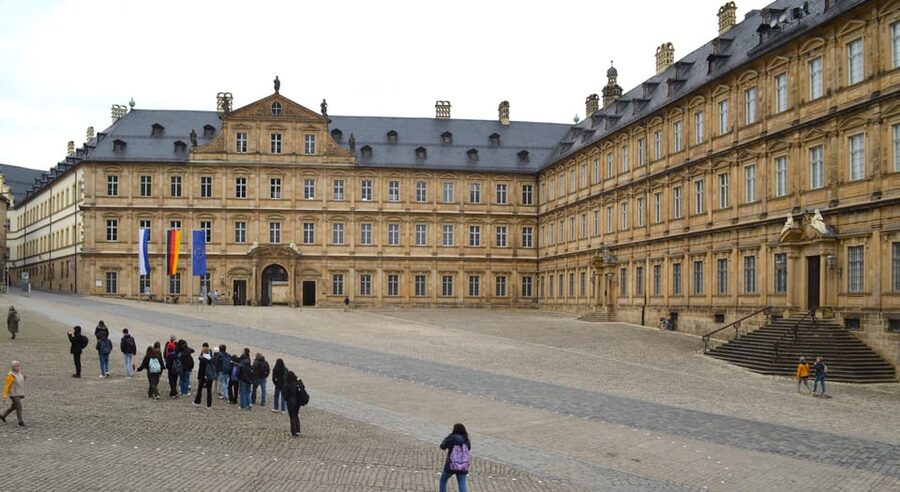
Domplatz brings several major Bamberg sights together. The square is home to the Old Court and Bamberg Cathedral, and the tour uses these landmarks to finish its sightseeing portion.
The Old Court, or Alte Hofhaltung, adds a strong medieval and princely setting to the route. Its enclosed historic character helps explain why filmmakers can use Bamberg as a substitute for places far beyond Bavaria. A guide can point out how the architecture works on screen, where a broad view establishes period and a narrow passage creates a more intimate scene.
Bamberg Cathedral gives the final section a grand finish. The cathedral is one of the city’s main landmarks, and seeing it after the smaller lanes and filming spots gives the route a satisfying change of scale. You move from intimate locations to the large civic and religious buildings that define the city center.
The tour finishes at Domplatz rather than returning to the starting point. That is convenient if you plan to continue sightseeing around the cathedral, Old Court, or nearby old-town streets. It also makes the walk easy to combine with a separate visit to Bamberg’s central sights.
The supplied information also refers to the medieval prison known as the Lochgefängnisse and to the history of witch hunts in Nuremberg. Those subjects may be part of the broader historical work associated with the provider, but the described film walk specifically ends at Domplatz and lists no separate Nuremberg stop. I would not book this experience expecting a Nuremberg excursion or a dedicated prison visit unless the organizer confirms that those topics are included in your specific departure.
What the guides add to the experience
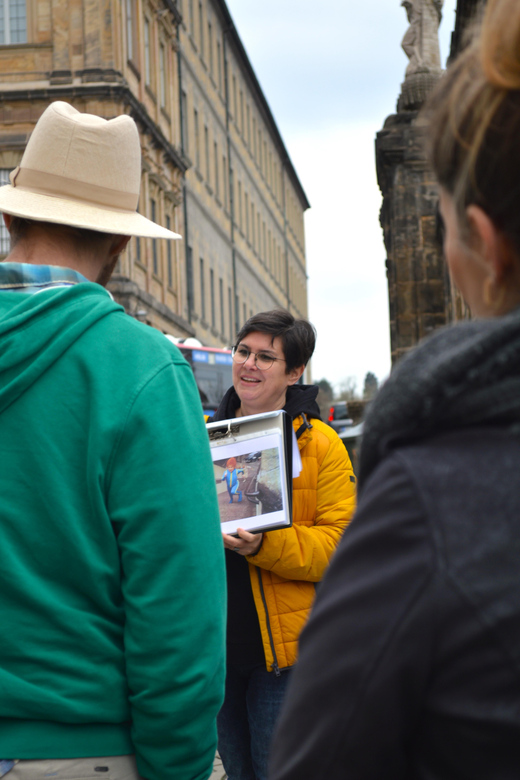
The guide can make or break a walking tour, and the available feedback points to a generally warm, relaxed style. Emma was praised for making the walk interesting and easygoing. Veronika was singled out for being friendly and handling children’s questions well.
Brid also received positive comments for guiding people through Bamberg. The caution is important, though: one group found the tour overbooked, with more than the expected maximum of 25 participants. The result was that Brid became difficult to hear and some information was missed.
That is not a small issue. A film-location tour depends on seeing the picture folder and hearing the explanation at each stop. If the group is too large, you may stand farther from the guide, lose parts of the story, or miss the comparison between the real location and the film scene.
For the best experience, stay near the guide when the group gathers. If you are booking for 10 or more people, contact Geschichte Für Alle e.V. by email at [email protected]. That gives the provider a chance to handle the booking as a group rather than leaving you to sort out a large party on the day.
The tour is offered in German only. That is the single biggest suitability question. If you understand German, the film stories and city details should make the walk lively. If you do not, the locations and photographs may still be interesting, but you will miss much of the explanation.
Is $15 good value for two hours?
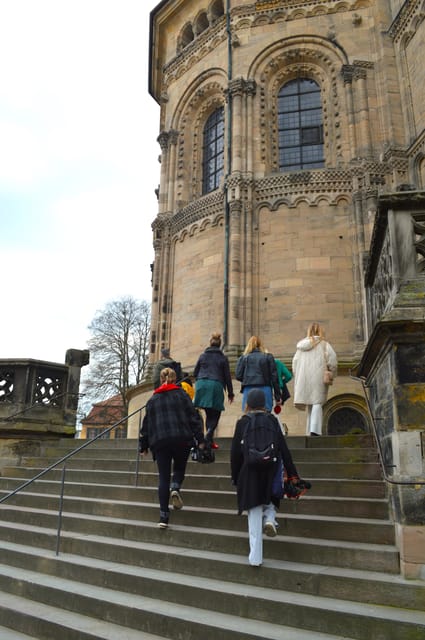
At $15 per person, this is a reasonably priced guided walk. You are paying for two hours with a live guide, a themed route through central Bamberg, and film images that help explain the locations. There are no listed admissions, food, or transport costs included, but the route itself is built around places you can see from the public streets and squares.
The value is strongest if you already like German cinema, family films, period productions, or the practical side of movie-making. It is also a good choice if you want an introduction to Bamberg that feels less formal than a standard old-town history tour.
The value is weaker if you want a general tour in English, a full historical survey of Bamberg, or a detailed visit inside every landmark. This is a focused film walk with old-town highlights, not a complete city tour.
Flexible booking adds some practical value. You can reserve and pay later, and cancellation is free up to 24 hours before the tour for a full refund. Bookings made through GetYourGuide do not receive a separate invoice, so the booking confirmation serves as proof of payment.
Who should book this Bamberg film walk?
I would choose this tour for:
- German-speaking visitors who enjoy movies and old towns
- Families looking for a city walk that can hold children’s attention
- Film fans curious about real locations behind familiar scenes
- First-time visitors who want a short introduction to Bamberg’s central sights
- Anyone interested in how streets and historic buildings are adapted for filming
I would choose something else if you need an English-language tour, dislike standing in groups, or want a full architectural and political history of Bamberg. I would also check the expected group size if hearing every word matters to you.
Should you book it?
Book it if the idea of seeing Bamberg as both a real city and a movie set sounds appealing. The strongest features are the direct film-scene comparisons, the attention given to The Three Musketeers, and the friendly approach reported from guides including Emma and Veronika.
At $15, the walk offers a lot of context for a modest price. Just keep your expectations clear: it is a German-language, two-hour walking tour focused on film locations, with selected old-town highlights rather than a full survey of every Bamberg story. If you can follow German and avoid an oversized group, this is a clever way to see familiar sights with fresh eyes.
FAQ
How much does the Bamberg film tour cost?
The tour costs $15 per person.
How long does the tour last?
The guided walk lasts two hours.
Where does the tour begin?
It begins at Obere Brücke 2 in Bamberg, at the entrance of the Altes Rathaus.
How can I identify the guide?
The guide will hold a picture folder and wear a name tag from Geschichte Für Alle e.V.
Where does the tour finish?
The tour finishes at Domplatz.
Is the tour conducted in English?
No. The live tour guide and tour language are German.
Is the tour wheelchair accessible?
Yes, the activity is listed as wheelchair accessible.
Which films are discussed during the tour?
The tour discusses The Flying Classroom, The Sams, The Three Musketeers, and the Netflix series The Empress.
Can I cancel the booking for a refund?
Yes. You can cancel up to 24 hours in advance for a full refund.
Can groups of 10 or more join the tour?
Yes, but groups of 10 or more should contact Geschichte Für Alle e.V. by email at [email protected].
Just added around the world
- Zion: Harry Potter-Inspired Zion Ghost Tour with Sunset View★ 5.0 · 8 reviews
- York: Game of Thrones Walking Tour★ 5.0 · 2 reviews
- Skopelos Island: Mamma Mia Filming Locations Tour★ 4.9 · 32 reviews
- Wellington: Lord of the Rings Filming Locations Tour★ 4.0 · 6 reviews
- Wellington: Half-Day Lord of the Rings Locations Tour★ 4.8 · 10 reviews
- Volcano Movie – Experience the Latest Eruptions in Iceland★ 3.6 · 3 reviews
- Wellington: Lord of the Rings Half-Day Guided Tour inc Weta★ 5.0 · 5 reviews
- Movie World, Sea World, & Wet’n’Wild Multi Park 1-Day Pass★ 4.1 · 4 reviews
Hollywood and Celebrity Home Tours, compared.
Full-Day Iconic Sights of LA, Hollywood, Beverly Hills, Beaches and More
Read our review →
Hollywood, Beverly Hills & Celebrity Homes Tour by Open Air Bus
Read our review →
Full-Day LA Tour: Santa Monica, Hollywood and Beverly Hills
Read our review →

Hollywood & Celebrity Homes Open-Air Bus Tour
Read our review →Lists this tour appears in